
Probate Is a District Court Matter in Marshall County
Marshall County does not have a stand-alone probate court. Probate is a division of the District Court, the same general jurisdiction court that hears felony, civil, and family cases in Madill. The authority comes from Oklahoma's probate statute, Title 58 of the Oklahoma Statutes, which gives the District Court power to receive proof of wills, admit or revoke probate, allow and record foreign wills, and grant letters testamentary, letters of administration, and letters of guardianship.
Probate covers more than just wills. The court handles estates of people who died with a will and people who died without one. It supervises guardianships for minors and for adults who cannot care for themselves, conservatorships over property, and trust proceedings. Marshall County's Court Clerk lists probate among the divisions her office serves, so the case files, dockets, and orders live with the same clerk who keeps the rest of the District Court record.
Because probate is a county court matter, it stays separate from federal estate and bankruptcy cases. Those run through the federal system and a different access portal.
Probate Terms Defined
Probate filings use words that rarely show up anywhere else, and a quick reading of a docket goes faster once the labels make sense. The terms below appear throughout Marshall County estate and guardianship cases.
- Testator
- The person who made the will. The estate of a testator is settled according to that will once the court admits it to probate.
- Executor
- The person named in a will to carry it out, gather the assets, pay debts, and distribute what remains.
- Administrator
- The person the court appoints to settle an estate when there is no will or no named executor able to serve.
- Intestate
- Dying without a valid will. The court then distributes the estate under Oklahoma's order of inheritance.
- Guardianship
- A court arrangement giving one person authority over the care of a minor or an adult who cannot manage personal needs.
- Conservatorship
- A court arrangement giving one person authority over the property and finances of someone who cannot manage them.
How to Search Marshall County Probate Records
The county links its court searches to On Demand Court Records (ODCR), and the statewide Oklahoma State Courts Network (OSCN) is the second official route. Both are free for public docket searching. Probate uses the same search screen as every other case type, so the trick is choosing the right court and the right category before you run a name.
ODCR lists several probate categories you can pick under Type of Case: Probate Proceedings, Probate Miscellaneous Proceedings, Guardianships, Conservatorship, Trust Proceedings, and Filing of Wills. Marshall County probate cases carry a case number that starts with the PB prefix, then the year, then a sequence number, written as PB-year-number. The sample estate case below uses that exact format.
- Open ODCR and set the Court group to Oklahoma District Courts, then choose Marshall so the search stays in the county.
- Pick a probate Type of Case, such as Probate Proceedings, Guardianships, Conservatorship, Trust Proceedings, or Filing of Wills.
- Search by party name entered as "Last, First," or enter a full PB case number if you already have it.
- Use a filed-date range when a common surname returns too many estates to scan.
- Open the case to read the parties, attorneys, events, docket entries, and any linked document images.
Note: The online docket is a finding tool, not the certified record, so confirm document images, sealed status, and older estate files with the Court Clerk.
Inside a Marshall County Probate Case File
A probate file reads as a timeline that opens the estate, gives notice to heirs and creditors, settles claims, and closes with distribution. The Marshall County estate case PB-2024-00029 on OSCN was filed July 9, 2024, before Judge Gregory L. Johnson, and it shows the full shape of an administration case from petition to discharge.
The header names the District Court in and for Marshall County, the matter as the estate of a deceased person, and the case number. From there the file moves through events such as Letters Administration Filed, Probate Docket, and Court Order Probate. The fields below map what each part of the record holds.
| Record Field | What It Shows |
|---|---|
| Header | District Court in and for Marshall County, the matter title, the PB case number, the filing date, and the judge. |
| Parties | The decedent or estate name, shown as the plaintiff in the static record. |
| Attorneys | Attorney name, firm, post office box, and city, state, and ZIP for counsel of record. |
| Events | Scheduled steps such as Letters Administration Filed, Probate Docket, and Court Order Probate. |
| Docket entries | Date, code, description, count, party, and amount for each filing and order. |
| Documents | Many lines marked as a document available with a number and a PDF or TIFF image link. |
The docket entries in that estate tracked the petition, notice and order for a hearing on letters of administration, affidavits of mailing and publication, notice to creditors, the order appointing an administrator, the letters themselves, a creditor's claim, an inventory and appraisal, a first and final account, a petition for decree of distribution, and the closing decree that discharged the administrator. Each step is its own dated line, which is why a probate docket can run long even on a routine estate.
The Marshall County Probate Process
Probate follows a set order, and knowing the sequence helps you read where a case stands when you open it online. Not every estate needs the full process, so the first decision is whether formal probate is required at all.
- Decide whether formal probate is needed or whether a small-estate affidavit might handle the transfer instead.
- File the probate petition or application in Marshall County District Court when venue is proper.
- Submit the will, the death certificate or other required supporting documents, and the proposed orders and notices.
- The court may appoint a personal representative or administrator, issue letters, order notice to heirs and creditors, and require an inventory and accounting.
- Claims, property sales, heirship questions, contested wills, and guardianship issues are resolved by court order.
- Certified copies of letters, orders, and the final decree come from the Court Clerk once the case is set.
Guardianship and conservatorship cases follow their own track, opening with a petition, a hearing, and an order that names the guardian or conservator and defines what authority the court grants.
Probate Filing Fees in Marshall County
Marshall County's official fee page links to Court Clerk fees on OSCN rather than printing local probate amounts, so the current filing and certified-copy figures should be confirmed through the Court Clerk or OSCN before you rely on them. The clearest local data point is the opening petition in case PB-2024-00029, which showed a $135 filing amount plus several statutory assessments layered on top.
A separate set of County Clerk fees applies when a probate order affects real property and has to be recorded in the land records or the judgment docket. Those recording charges are published on the county fee page and are listed below alongside the probate filing figure.
| Item | Amount |
|---|---|
| Probate petition filing (per sample PB-2024-00029) | $135 plus statutory assessments |
| Court Clerk filing and certified-copy fees | Confirm current amounts via Court Clerk or OSCN |
| County Clerk certified copy of a recorded order | $1 |
| County Clerk real estate recording, first page | $8 |
| County Clerk real estate recording, each additional page | $2 |
| County Clerk preservation fee per document | $10 |
The statutory assessments on a probate petition fund things like the law library, the dispute mediation program, the Oklahoma Court Information System, court clerk preservation, and courthouse security, which is why the total cost of opening an estate runs above the base filing line.
Where Marshall County Probate Records Are Kept
The Court Clerk holds the probate file and issues the certified letters, orders, and decrees that courts, banks, and title companies accept. Angela Maldonado has served as Marshall County Court Clerk since 2024, and her office keeps the permanent record for every probate, guardianship, and conservatorship case filed in the District Court. Call ahead for records that are not online, for older files, or for any sealed-status question.
Marshall County District Court, Court Clerk
Angela Maldonado, Court Clerk
PO Box 58
Madill, OK 73446
580-795-3278
Hours: 8:30 to 12:00 and 12:30 to 5:00
When a probate order transfers or clears title to land, the recorded copy moves to the County Clerk, who keeps the land records and the real-property judgment docket. Estates that include marriage or divorce questions can also touch the Court Clerk's other files, since the same office handles marriage and divorce records for the county.
Federal Estates and PACER
County probate is the right venue for almost every Marshall County estate, but a few matters reach the federal system instead. Federal tax disputes tied to an estate, bankruptcy filings that overlap with an inheritance, and lawsuits between an estate and out-of-state parties can land in the U.S. District Court for the Eastern District of Oklahoma, which includes Marshall County. Those cases are not searchable through ODCR or OSCN.
Federal case records come from a separate national system, the Public Access to Court Electronic Records service at PACER.
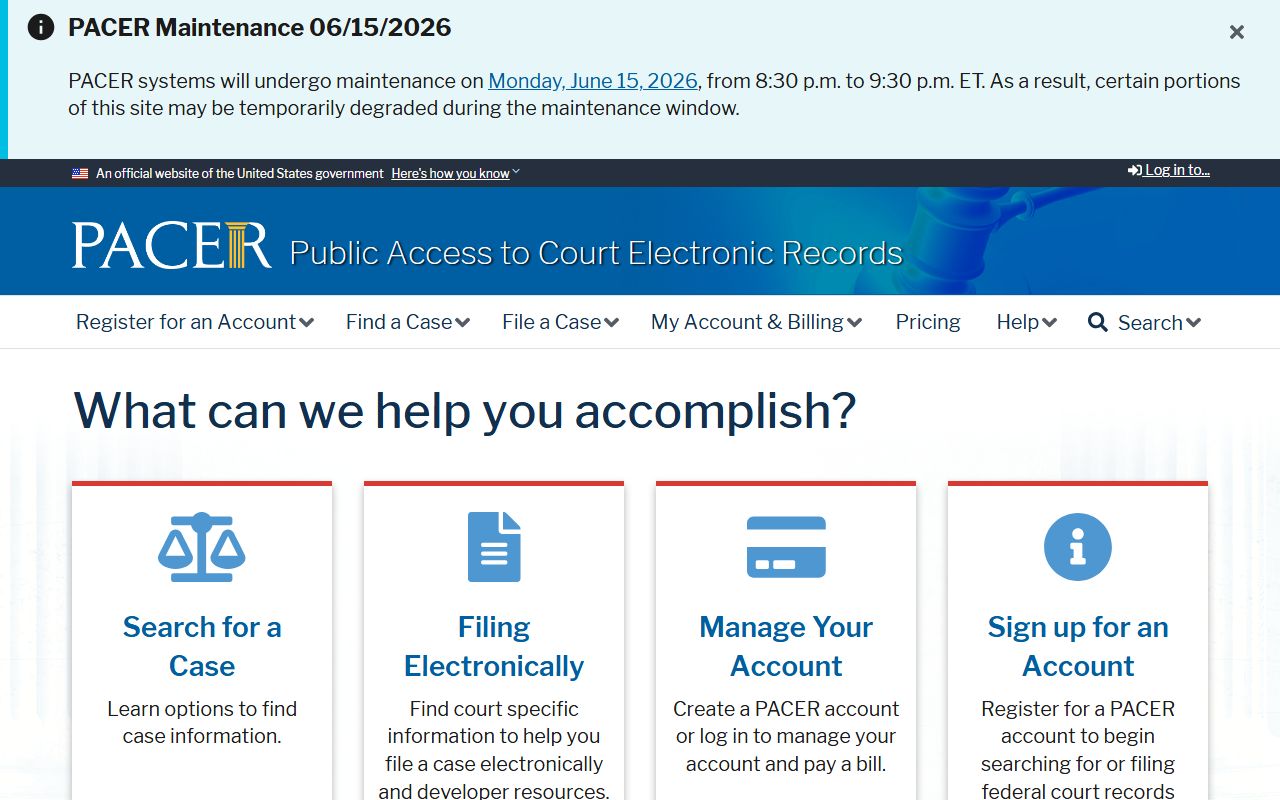
PACER requires a registered account and charges per page for most documents, which is the opposite of the free county docket searches at ODCR and OSCN. For a routine Marshall County estate, the District Court and the Court Clerk remain the place to look, and PACER only enters the picture when a federal court is actually involved.
Restricted Marshall County Probate Records
Most probate dockets are open under the Oklahoma Open Records Act, but parts of a file can be limited. Cases involving minors, guardianships, medical incapacity, or adoption-related issues often hold sensitive material that the public docket does not display in full.
A public search can confirm that a case exists and show its events, while the underlying documents may require in-person access at the Court Clerk's office or may be sealed by court order. Guardianship and conservatorship files in particular protect health and personal information about the people under the court's care.
When a document is missing online, that absence does not mean the record does not exist. It usually means the image is held at the courthouse or restricted, and a call to the Court Clerk is the next step. For broader background on how the county handles open and closed files, the county's general court records guidance lays out the same access framework.