
Criminal Court Records in Marshall County
A criminal court record is the full case file the District Court opens when the State of Oklahoma charges someone. The Court Clerk, Angela Maldonado, records and keeps the permanent file for every criminal case in the county. That file holds the charges, each hearing, every plea or motion, the judge's orders, and the final outcome. It is the official court account of a prosecution. It is not a police report, and it is not a jail booking sheet. The record begins only after charges are filed, so an arrest with no charge may never produce a court file.
Marshall County criminal cases are heard in the District Court, the trial court of general jurisdiction. Felony files carry a CF prefix and misdemeanor files carry CM. The county sits in Oklahoma's Twentieth Judicial District with Carter, Johnston, Love, and Murray Counties. City ordinance and municipal traffic cases are handled in municipal court and usually do not appear in the District Court docket. For the wider set of civil, family, traffic, and probate matters, the broader Marshall County court records search covers every case type the clerk maintains.
How to Search Marshall County Criminal Court Records
Marshall County links its public court search to On Demand Court Records, known as ODCR, the same portal the Court Clerk page points to for case lookups. The Oklahoma State Courts Network, or OSCN, is the statewide alternative and carries the same Marshall County dockets. Both are free to search.
- Open the ODCR public search and set the court group to Oklahoma District Courts.
- Choose Marshall from the court list to limit results to the local District Court.
- Search by defendant name in Last, First format, or enter a full case number such as CF-2026-00018.
- Narrow with the case type and filed-date filters when a common name returns too many hits.
- Open the case to read the parties, counts, docket entries, and disposition, then ask the Court Clerk for a certified copy if you need an official version.
OSCN offers a second official route through its statewide docket search, which helps when ODCR is slow or when a case touches more than one county. Both portals draw from the same District Court file, so the case number is the surest way to land on the right record.
Note: The online docket is a finding tool, not the certified record, so confirm any detail with the Court Clerk at 580-795-3278 before relying on it.
Stages of a Marshall County Criminal Case
A criminal case moves through set stages, and each one leaves a mark on the record. It starts when the District Attorney files an information, the charging document, after an arrest or citation. The defendant then has an initial appearance, bond is set, and felony cases receive preliminary hearing conferences before any trial. Every step attaches to one case number, so the docket reads like a timeline.
The District 20 District Attorney, Melissa Handke's office, decides which charges to file and prosecutes them across the five-county district.
Once that filing reaches the clerk, the criminal court record opens, and every later hearing, motion, and order is added to the same file under the assigned judge, often Gregory L. Johnson.
Case flow: Charges Filed › Arraignment › Pretrial / Motions › Plea or Trial › Disposition › Sentencing
| Stage | What Happens |
|---|---|
| Arraignment | The defendant hears the charges and enters a plea of guilty, not guilty, or no contest. The record logs the date, the judge, and the plea. |
| Pretrial / Motions | Lawyers file motions, exchange evidence, and argue bond or suppression issues. Felony files also show preliminary hearing conferences. |
| Plea or Trial | Most cases end in a plea agreement. Others go to a bench or jury trial, and the docket records each setting and ruling. |
| Sentencing | After a guilty plea or verdict, the judge orders a fine, jail or prison time, probation, or a deferred or suspended sentence. |
The charges themselves, including how a count can be amended, reduced, or dropped, are covered more closely in the Marshall County court charge records.
What a Marshall County Criminal Court Record Shows
A criminal case file packs a lot of detail into a few screens. The header names the court and the parties. The body lists the counts, the hearings, and the dated docket entries. A felony file like the sample case CF-2026-00018 shows the State of Oklahoma against the defendant, the assigned judge, and the financial line items the clerk tracks. The fields below appear on most Marshall County criminal dockets.
| Field | What It Shows |
|---|---|
| Case Number | The prefix-year-sequence label, such as CF-2026-00018 for a felony or a CM number for a misdemeanor. |
| Court and Judge | The District Court in and for Marshall County and the assigned judge, often Gregory L. Johnson. |
| Parties | The State of Oklahoma, the defendant, the District 20 District Attorney, and the arresting officer and agency, such as the Madill Police Department. |
| Defense Attorney | The lawyer of record and the party represented, including counsel appointed through the state indigent defense system. |
| Counts and Charges | Each numbered count, the charge name, and the statutory code, for example possession of a firearm after a former felony conviction. |
| Plea | The defendant's response to each count: guilty, not guilty, or nolo contendere. |
| Docket Entries | Dated line items for filings, bonds, hearings, and orders, each with a code, description, count, party, and amount. |
| Disposition | The outcome of each count: conviction, dismissal, acquittal, deferred sentence, or transfer. |
| Sentence | Any fine, custody term, probation, or deferred or suspended terms ordered after a conviction. |
| Financial Assessments | Filing fees plus law library, sheriff, AFIS, CLEET, forensic, victim services, court information system, courthouse security, bond, and incarceration fees. |
Charges vs. Convictions
Being charged is not the same as being convicted. A criminal court record can show counts that were later dropped, dismissed, or ended in acquittal. A charge is only an accusation. A conviction is a finding of guilt by plea or verdict. Reading the disposition for each count is the only way to tell the two apart.
Defendants who cannot afford a lawyer may receive appointed counsel through the Oklahoma Indigent Defense System when the court finds them eligible.
Their representation shows up in the attorney section of the docket, the same place a privately hired lawyer appears, which is why the file can confirm who argued a case but not whether a charge ever stuck.
| Charge | Conviction | |
|---|---|---|
| Stage | Accusation | Verdict or plea |
| Burden of Proof | Probable cause | Beyond reasonable doubt |
| What It Means | The case is open or pending | Guilt has been established |
| Public Record | Yes | Yes |
Reading Dispositions and Sentences
A disposition is the outcome the court records for each count. Guilty and nolo contendere both lead to a conviction. Not guilty means an acquittal. Dismissed means the count ended without a conviction. The docket may also show a deferred sentence, where the judge holds off on judgment while the defendant meets set conditions.
Sentences read differently from charges. A line may set jail time, a prison term, probation, fines, or a suspended sentence served outside custody. Deferred and suspended terms are common in Marshall County files, so read the full docket before you assume the result.
Note: A deferred sentence that is completed can be dismissed and may later qualify for sealing, so a guilty plea does not always remain a conviction.
Sealed vs. Expunged Records
Oklahoma law lets some criminal records be removed from public view. The process runs under Title 22, Section 18, which sets the eligibility categories by statute. The Oklahoma State Bureau of Investigation stresses that it cannot pre-approve eligibility, so a person must check the statute or ask a lawyer. Sealing hides a record from ordinary public access, while a full expungement treats the file as if it never existed. A specific filing fee was not located in official sources, so the Court Clerk is the place to confirm current cost.
| Sealed | Expunged | |
|---|---|---|
| Visibility | Hidden from public | Treated as never existed |
| Law Enforcement | Limited access | Very limited |
| Eligibility | Set by court order under 22 O.S. 18 | Statutory categories per OSBI guidance |
Public Access to Marshall County Criminal Court Records
Oklahoma treats court records as public unless a statute closes them. The Open Records Act sets that baseline, and criminal case files are open for inspection during regular business hours. The Court of Criminal Appeals has also held that the online docket is a convenience, not the official record, which is why the clerk's copy controls when accuracy matters. Most Marshall County criminal court records are searchable for free through the county-linked portals.
Key Statutes:
Oklahoma Open Records Act, 51 O.S. § 24A.1 - court and agency records are open to the public unless a specific statute makes them confidential.
Court of Criminal Appeals Rule 2.6 - the OSCN online case search is a public convenience and does not replace the official court file.
Background Check Considerations
Many people search criminal court records to vet a tenant, a date, or a job applicant. Casual lookups for personal knowledge are fine. Formal screening for employment, housing, credit, or insurance must follow the federal Fair Credit Reporting Act, which sets accuracy, consent, and notice rules that a raw court docket alone does not meet. A single docket can also miss sealed history or pending appeals.
Important: This site is not a consumer reporting agency under the FCRA, and its records may not be used for employment, tenant, credit, or insurance decisions.
Restricted Criminal Court Records in Marshall County
Some criminal files stay closed even though the system is open. Juvenile cases lead the list. Active search warrants may be sealed while an investigation runs. Adoption and certain mental health filings are restricted, and personal identifiers like Social Security numbers are redacted from public dockets.
Juvenile matters are treated very differently, and the Oklahoma Office of Juvenile Affairs explains that most juvenile records are confidential under state law.
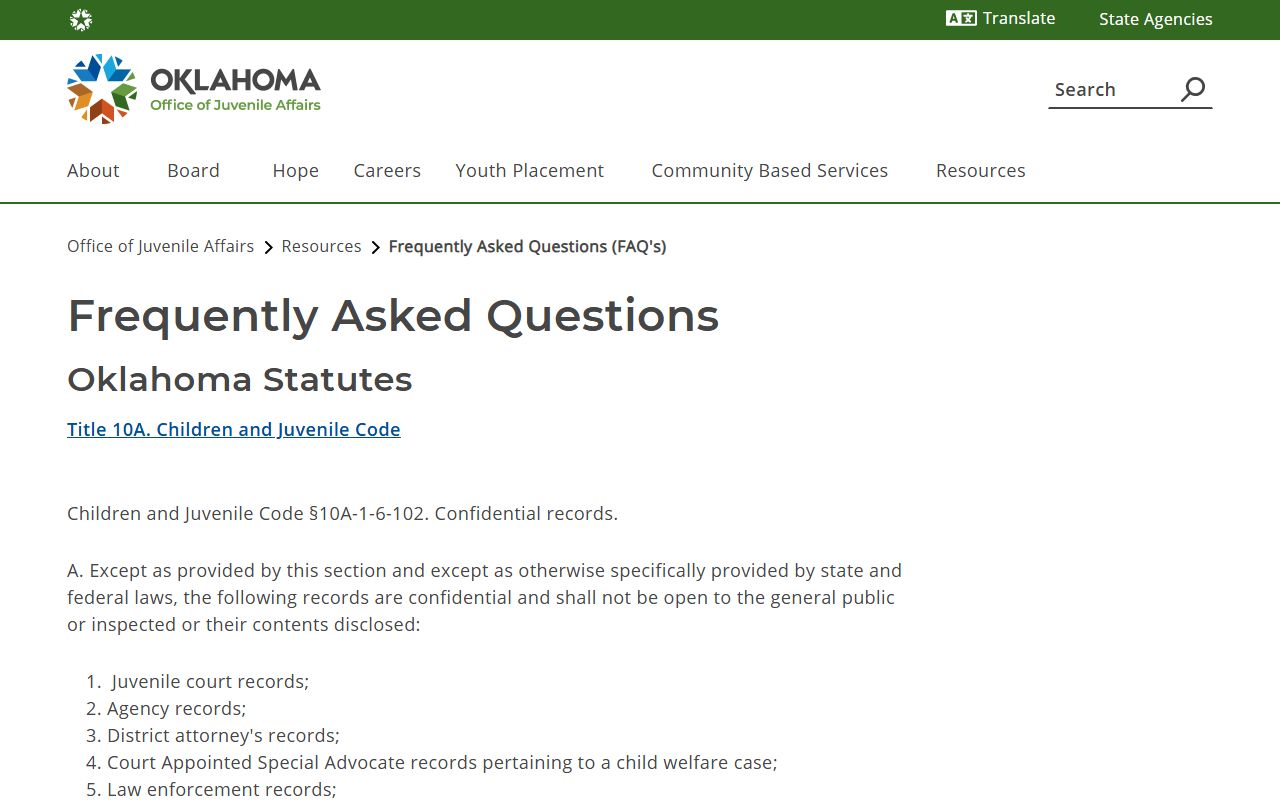
Because 10A O.S. 1-6-102 shields those files, they do not appear alongside adult criminal dockets in the public search, and the Court Clerk can explain what access, if any, a party may request.
Note: Sealed and expunged cases drop out of public results, so a name that returns nothing may still have a closed criminal history.