
Marshall County Arrest Records and Court Charges
A Marshall County arrest record is the account of an arrest itself. It notes who was taken into custody, which agency made the arrest, and the booking that follows at the county jail. In a sample felony case from the county, the court file even names the arresting officer and the arresting agency, listed as the Madill Police Department. An arrest, though, does not set the charges. That decision belongs to the prosecutor. The District 20 District Attorney reviews the case and files the formal charges with the Court Clerk, where they become the charge record tied to a case number.
The arrest side and the charge side live in different places. Booking and custody detail sit with the sheriff and the jail, so the Marshall County inmate records page is the better stop for the jail roster and who is held right now. The court charges after arrest sit with the District Court, tracked from the first filing through every later change. Once a case opens, the full file holds far more than the charges alone. For pleas, hearings, verdicts, and sentencing, the Marshall County criminal court records hold the complete case history.
How to Find Marshall County Arrest Records and Charges
Charges and their current status show up in the public court case search. Marshall County links the public to On Demand Court Records, known as ODCR, for court records and warrant checks, and the statewide Oklahoma State Courts Network, or OSCN, is a second official route. Both are free to search. Arrest and booking detail, by contrast, comes from the sheriff and jail rather than the court docket. Start with the court search to read the charges, then turn to the jail for custody facts.
- Open ODCR and choose Oklahoma District Courts, or leave the court group set to all courts.
- Select Marshall from the court list, then search by defendant name entered as Last, First, or by full case number.
- Open the matching case and read the list of counts, each with its charge text and statutory code.
- Check every charge for its level and current status, since one arrest can produce several counts that move at different speeds.
For a charge history that reaches beyond one county, the Oklahoma State Bureau of Investigation keeps statewide criminal records. ODCR and OSCN show what was filed locally. Records that are not posted online, or older files, can be confirmed by calling the Court Clerk at 580-795-3278.
The Oklahoma Supreme Court documented a visit by Chief Justice Rowe to the Marshall County District Court, the court that holds these charge records.
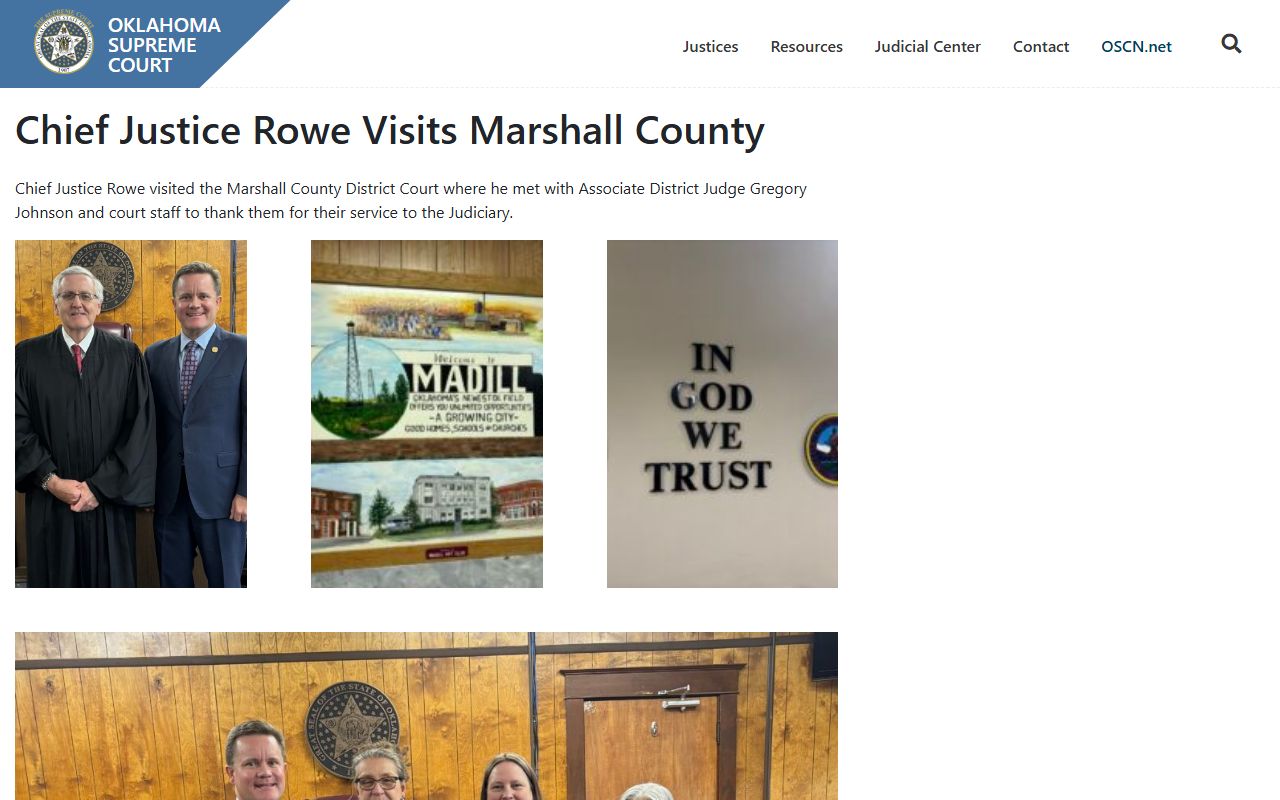
That same District Court is where charges filed after a Marshall County arrest are docketed, amended, and finally resolved. Reading the docket there is the surest way to track each count.
Note: ODCR and OSCN are convenience tools, so verify any certified copy or sealed-status question directly with the Marshall County Court Clerk.
How Charges Get Filed After a Marshall County Arrest
The charge record begins when a prosecutor files a charging document, not at the moment of arrest. After booking, the District 20 District Attorney reviews the case and decides what to file. Oklahoma most often uses an Information, the prosecutor's own sworn charging document, to bring felony and misdemeanor charges. A grand jury indictment is reserved for certain serious matters. Early on, ODCR may even list a case under Criminal Probable Cause or Criminal Proceedings - Not Filed, which signals an arrest under review before formal charges land.
| Complaint | Information | Indictment | |
|---|---|---|---|
| Filed By | Officer / Prosecutor | Prosecutor | Grand Jury |
| Common For | Misdemeanors | Many felonies | Serious felonies |
| Starts | The case | The case | The case |
Each path ends the same way, with a case number and an open court file. In Oklahoma the Information does most of the work, since the District Attorney can file felony and misdemeanor charges directly without waiting on a grand jury. A felony Information still has to clear a preliminary hearing, where a judge weighs whether the evidence is strong enough to send the charge forward. That step is why a felony charge can appear, then be bound over, reduced, or thrown out before any trial. The statewide list of district attorneys, kept by the Oklahoma District Attorneys Council, confirms District 20 covers Marshall and four neighboring counties.
Charge Status in Marshall County Court Records
Charges rarely stay frozen. As a case moves, a count can be amended, reduced to a lesser offense, added, dropped, or dismissed outright. The docket records each change with a date, so the current status may differ from what was first filed after the arrest. Reading the latest entries matters, because an old charge label can mislead once a case has progressed.
| Status | What It Means |
|---|---|
| Filed | The prosecutor has formally entered the charge and the case is open. |
| Pending | The charge is active and awaiting a hearing, plea, or trial. |
| Amended / Reduced | The prosecutor changed the charge, often to a lesser offense. |
| Dismissed | The court dropped the charge, and it is no longer being pursued. |
| Nolle Prosequi | The prosecutor chose not to pursue the charge, ending it without a verdict. |
| Bound Over | A judge found enough evidence at a preliminary hearing to send a felony charge forward. |
Note: A charge marked dismissed or nolle prosequi still appears in the public file even though it is no longer being pursued.
Marshall County Charges vs. Convictions
Being charged is not the same as being convicted. A charge is an accusation backed only by probable cause, the lower standard needed to file. A conviction comes later, after a guilty or no contest plea or a verdict, and it requires proof beyond a reasonable doubt. Both appear in the public court record, so a search can show open charges, dropped charges, and convictions side by side. Reading the disposition for each count is the only reliable way to tell them apart.
| Charge | Conviction | |
|---|---|---|
| Stage | Accusation | Verdict or plea |
| Burden of Proof | Probable cause | Beyond reasonable doubt |
| Public Record | Yes | Yes |
Sealed vs. Expunged Records in Marshall County
Some charge records can be removed from ordinary public view. Oklahoma law sets statutory categories for expungement under Title 22, and the Oklahoma State Bureau of Investigation says it cannot pre-approve eligibility because the categories are fixed by statute. A sealed record is hidden from public searches but still reachable by limited agencies. An expunged record is treated as though it never existed for most purposes. Neither happens on its own. A person must qualify under the statute, file in the proper court, and obtain a signed order before the change takes effect.
| Sealed | Expunged | |
|---|---|---|
| Visibility | Hidden from public | Destroyed / treated as never existed |
| Law Enforcement | Limited access | Very limited |
| Eligibility | Set by 22 O.S. Section 18 | Set by 22 O.S. Section 18 categories |
Note: An expungement order does not erase a record everywhere, since agencies and courts keep authority to act under the order and statute.
Marshall County Charge Codes and Severity Levels
Each charge ties to a specific Oklahoma statute, and the court file shows that citation next to the charge text. Case numbers also signal the charge level. A CF prefix marks a felony case, while CM marks a misdemeanor, and the count detail names the exact offense, such as the firearm count in a recent Marshall County felony filing. Felonies carry the most serious penalties, misdemeanors carry lighter ones, and a single arrest can generate several separate counts that each get their own code and status. Reading every count, not just the first, gives the full picture.
Severity also drives where a case is handled and how long it can stay open. Felony counts move through initial appearance, bond, and a preliminary hearing before arraignment, while many misdemeanors resolve faster. The docket lists fees and assessments tied to each stage, so the financial entries often hint at how far a charge has traveled. None of that changes the core fact that a code is a label for an alleged offense, not proof of guilt.
Statewide Charge and Criminal History Lookups
County court searches cover what was filed in Marshall County, but a person's full criminal history can span many counties. The Oklahoma State Bureau of Investigation keeps the statewide criminal history record and handles expungement processing under state law. Its guidance explains that statutory eligibility, not agency discretion, controls whether a record can be sealed. For court documents themselves, the Oklahoma Open Records Act keeps District Court files generally open, though confidential categories still apply.
Court rules underline the gap between a quick online check and the official record. The Oklahoma Court of Criminal Appeals treats the online case search as a public convenience that does not replace the court's official case-management record. For a definitive charge history, the Court Clerk holds the certified file, and the state bureau holds the multi-county record.
Background Check Considerations
A casual court search is not the same as a regulated background check. Employers, landlords, and others who screen people for a fee must follow the federal Fair Credit Reporting Act, which sets rules for accuracy, notice, and dispute rights. Reading a free Marshall County charge record for personal knowledge falls outside those rules. People who cannot afford a lawyer for a criminal charge may qualify for the Oklahoma Indigent Defense System, which the court appoints once it finds a defendant eligible.
There is also a difference between what a charge shows and what a conviction means for screening. A dismissed or expunged charge should not be treated as a conviction. Anyone relying on a record for a regulated decision should confirm the disposition and use a compliant service rather than a casual docket search.
Important: This site is not a consumer reporting agency under the FCRA, and its records may not be used to decide employment, housing, credit, or insurance.
Restricted Charge Records in Marshall County
Not every charge record is open. Juvenile charges are confidential under Oklahoma law and do not appear on the public docket like adult cases. Sealed and expunged charges drop out of public view once a court orders it. Search warrant records may be delayed while an investigation stays active, and sensitive victim details in protective order or domestic matters can be withheld. When a charge that should appear is missing, the Court Clerk can confirm whether it is sealed, restricted, or simply not yet docketed.
Access can also depend on who is asking. When a statute makes a record confidential, the clerk may require party status, identification, attorney authority, or a court order before releasing it. The safest approach is to call ahead, describe the case, and ask what proof the office needs.